
What Is Matter? The Smart Home Standard Explained Simply
Matter aims to make smart home devices from different manufacturers work together more easily. Instead of needing a separate ecosystem for every device, Matter creates a common standard for communication between compatible devices.
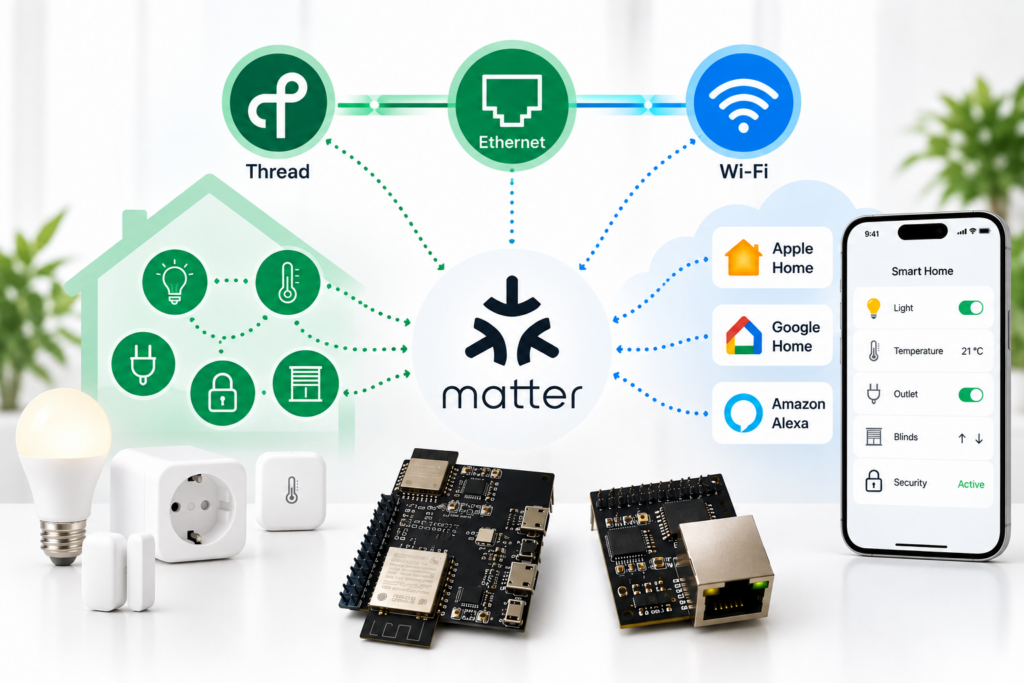
Matter itself is not a wireless technology. The standard uses existing IP-based networks such as Thread, WiFi or Ethernet. In this guide, we explain how Matter works, what role Thread and WiFi play, and why Matter can simplify networking in the smart home.
What Is Matter?
Matter primarily defines how devices communicate with each other and what functions they provide. For the actual network connection, Matter uses existing IP-based technologies such as Thread, WiFi or Ethernet. Matter is therefore not a wireless technology of its own.
Matter is a cross-manufacturer standard for smart home devices. The goal is for compatible devices from different manufacturers to work together more easily and integrate into different smart home systems. Matter is developed by the Connectivity Standards Alliance (CSA).
How Does Matter Work?
Matter is based on the Internet Protocol (IP). This allows Matter devices to communicate with each other over different network technologies, as long as they are part of a compatible Matter infrastructure.
The network connection primarily relies on Thread, WiFi and Ethernet. WiFi and Ethernet connect devices directly to the existing IP network. For Thread devices, a Thread Border Router handles the connection between the Thread mesh network and the rest of the IP network.
The advantage of this approach is that Matter is not tied to a single wireless technology. A smart home system can, for example, include battery-powered Thread sensors, WiFi devices and Ethernet-connected components at the same time.
Thread, WiFi and Ethernet in Matter
Which network technology a Matter device uses depends on the device and its intended use. The three technologies each have different strengths:
- Thread: Particularly suitable for energy-efficient devices such as sensors, switches or door contacts. Thread forms a mesh network and requires a Thread Border Router to connect to the rest of the IP network.
- WiFi: Well suited for devices with higher data requirements or a permanent power supply that can connect directly to the existing WiFi network.
- Ethernet: Provides a wired, stable connection to the local network and is particularly suitable for permanently installed devices, gateways and other infrastructure components.
Matter = a common standard that defines how compatible smart home devices communicate with one another.
Thread = an energy-efficient, IP-based mesh network for wireless devices.
WiFi = a wireless IP connection through which Matter devices can communicate directly with the local network.
Ethernet = a wired IP connection for devices and infrastructure components.
What Is the Difference Between Matter and Thread?
Matter and Thread are often mentioned together, but they serve different purposes. Matter defines how compatible smart home devices communicate with each other and can be controlled. Thread, on the other hand, provides a network technology that devices can use to transmit data.
A Matter device does not automatically have to use Thread. Matter can also be used via WiFi or Ethernet. Thread is mainly used for energy-efficient, battery-powered devices such as sensors, switches or door contacts.
If a Matter device uses Thread, a Thread Border Router is required to connect the Thread network to the rest of the IP network. We explain in detail what role it plays and how Thread and Ethernet work together in our guide to the Thread Border Router.
What Role Does a Thread Border Router Play in Matter?
A Thread Border Router is needed when Matter devices communicate via Thread. It connects the Thread mesh network to the rest of the IP network, for example a home network via Ethernet or WiFi.
The Border Router thus enables IP communication between Thread devices and devices or services outside the Thread network. In doing so, it does not translate Matter into a different protocol – Matter remains IP-based even across the network boundary.
For Matter devices connected directly to the local network via WiFi or Ethernet, however, no Thread Border Router is required. It is specifically needed to connect a Thread network.
What Are the Benefits of Matter?
Matter aims to simplify the setup and use of smart home devices and reduce dependency on individual manufacturer ecosystems. This offers users several benefits:
- Cross-manufacturer compatibility: Matter creates a common foundation so that compatible devices from different manufacturers can be used together.
- Simpler setup: Matter devices can be integrated into compatible smart home systems in a standardised way.
- Local communication: Many Matter functions can be carried out within the local network without requiring a cloud connection for every action.
- Multiple smart home systems: With the multi-admin feature, supported Matter devices can be shared with several compatible smart home ecosystems at the same time.
- Consistent security foundation: Matter defines security mechanisms for authentication and encrypted communication between devices.
However, which functions are actually available depends on the specific device and the smart home system used. Matter therefore does not automatically mean that every device offers the same range of functions in every ecosystem.
Which Devices Support Matter?
Matter is supported by an increasing number of smart home devices and device classes. Whether a specific product supports Matter and which functions are available, however, depends on the respective manufacturer and model.
- Lamps and lights – for switching, dimming or changing colour and colour temperature
- Sockets and switches – for switching connected devices and appliances
- Sensors – for example for motion, presence, temperature or the state of doors and windows
- Thermostats and air conditioning units – for controlling heating and room climate
- Door locks – for integrating compatible smart locks
- Blinds and shutters – for controlling shading systems
- Bridges, hubs and controllers – for integrating and controlling smart home devices
When purchasing, attention should therefore not be paid solely to the Matter logo. It is also crucial which device functions are actually supported by the respective smart home system.
Do I Need an Internet Connection for Matter?
Matter is fundamentally designed for local communication in the smart home. Many basic functions can therefore be carried out within your own network without control having to go through a cloud service every time.
An internet connection may still be required, for example for software updates, remote control while away from home, or additional cloud features from a manufacturer or smart home ecosystem.
Whether certain functions are available without an internet connection—and, if so, which ones—depends on the specific Matter device and the smart home system being used. A loss of internet connection does not automatically mean that local control of all Matter devices will also fail.
Matter Controller and Thread Border Router—which one do I need?
A Matter controller manages Matter devices within a smart home system. Among other things, it handles control functions and ensures that the integrated Matter devices can be used within the respective ecosystem.
A Thread Border Router has a different function: It connects a Thread mesh network to the rest of the IP network. It is required when Matter devices use Thread as their networking technology.
Both functions can be combined in a single device. For example, a smart home hub can function simultaneously as a Matter controller and a Thread border router. Whether this is the case depends on the specific product.
In short: The Matter Controller controls Matter devices. The Thread Border Router connects Thread devices to the rest of the IP network.
Matter in Practice: Integrating Thread Devices into the Network
A typical Matter network can include devices that use different network technologies. While Matter devices can be connected directly to the IP network via Wi-Fi or Ethernet, low-power Matter-over-Thread devices communicate within a Thread mesh network.
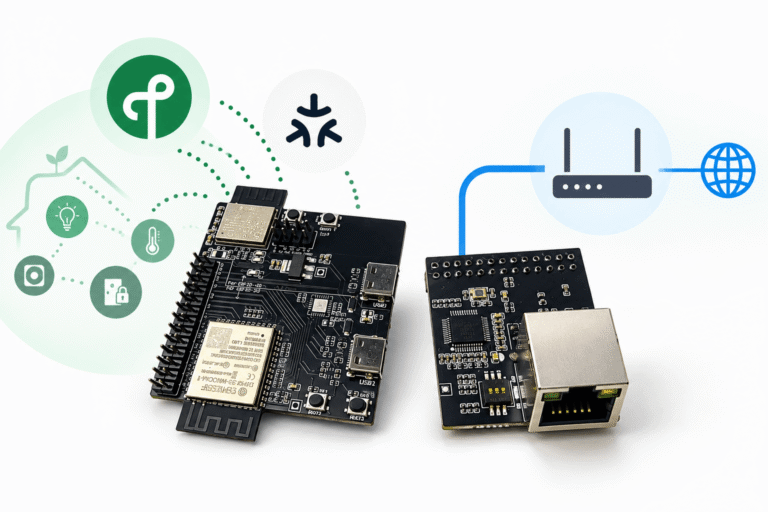
To allow these Thread devices to communicate with the rest of the IP network, a Thread Border Router is used. It establishes the connection between the Thread network and the existing home or development network.
Matter and Thread in Practice
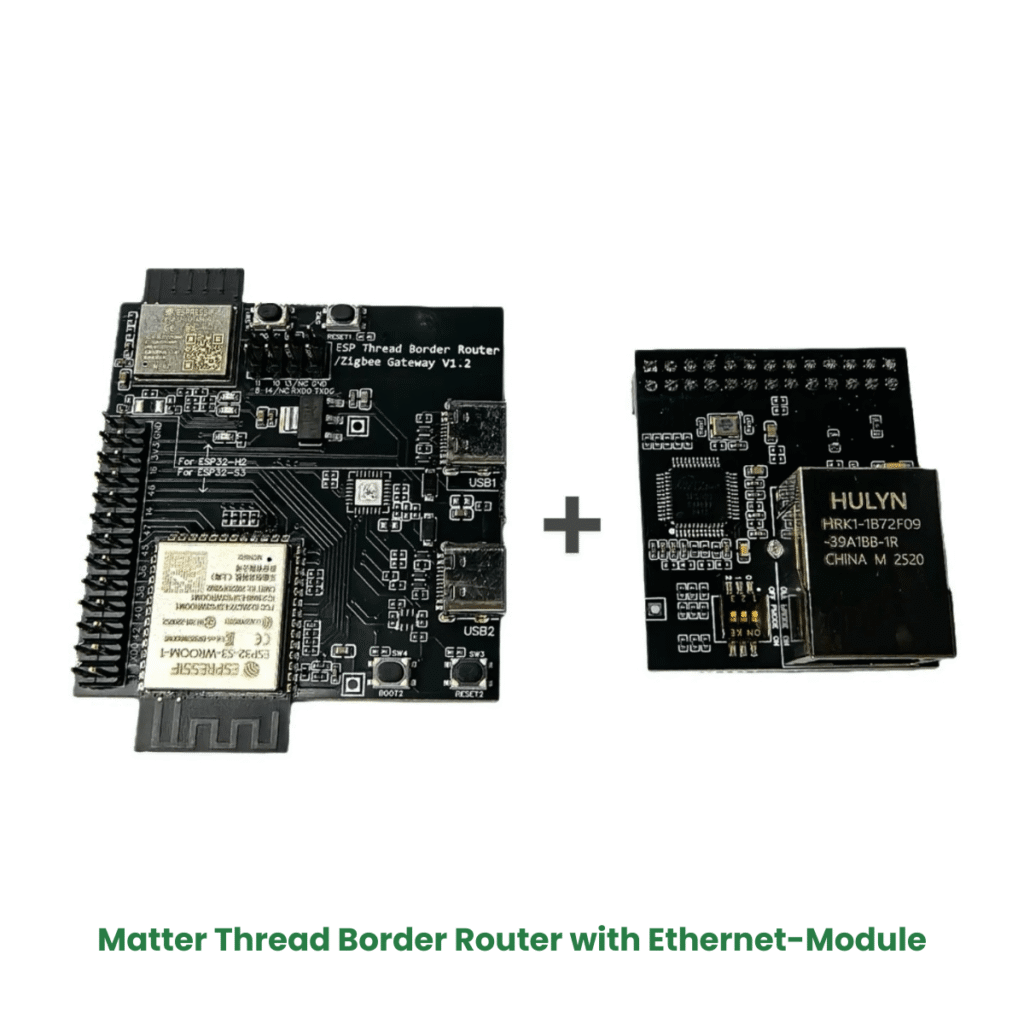
For developers and makers, ChipGlobe offers an ESP Thread Border Router with Ethernet. It is suitable, for example, for your own Thread and Matter test environments as well as for development projects where a Thread network needs to be connected to an Ethernet network.
Frequently Asked Questions About Matter
Conclusion: Matter Simplifies Networking in the Smart Home
Matter creates a common foundation for cross-manufacturer communication of smart home devices. Instead of introducing its own wireless technology, Matter uses existing IP-based networks such as Thread, WiFi and Ethernet.
Which network technology is used depends on the specific device. Particularly energy-efficient Matter-over-Thread devices can use a Thread mesh network, while other Matter devices communicate directly via WiFi or Ethernet.
For Matter over Thread, a Thread Border Router plays an important role: it connects the Thread network to the rest of the IP network. Matter and Thread thus complement each other, but fulfil different roles within a modern smart home.